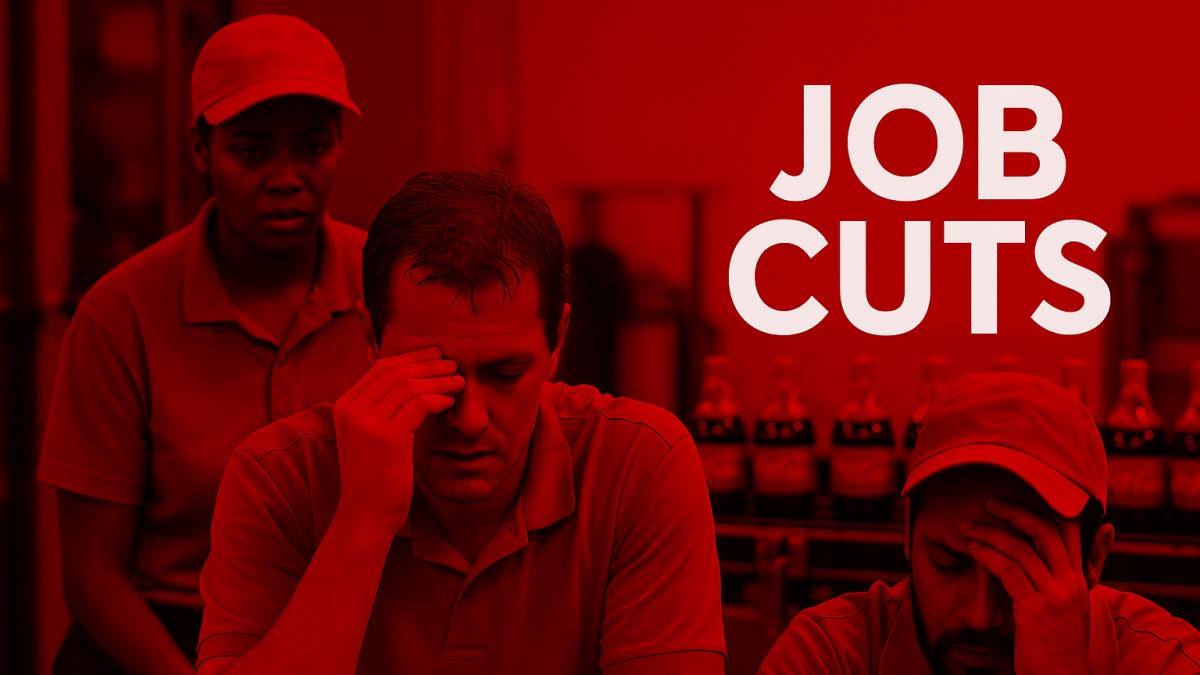
Coca-Cola South Africa job cuts are set to affect more than 680 employees, following the company’s announcement of a restructuring plan. Coca-Cola Beverages South Africa (CCBSA), a subsidiary of Coca-Cola Beverages Africa, confirmed that its bottling plants in Bloemfontein and East London will close, raising concerns in a country already battling a 33% unemployment rate.
Coca-Cola South Africa Job Cuts and Restructuring Strategy
The Coca-Cola South Africa job cuts form part of a consolidation strategy designed to improve efficiency and reduce operating costs. On 17 September, CCBSA explained that production will be centralised at its newly developed $20.5 million Midrand facility, which will become the hub for operations going forward.
Despite this investment, the company stated that financial pressures and market realities make plant closures unavoidable. While CCBSA has promised separation packages for affected employees, the decision highlights the growing wave of retrenchments in South Africa’s corporate sector. Over the past year, Mercedes-Benz cut 702 jobs, Ford Motors 470, Goodyear 900, Aspen 923, and ArcelorMittal 4,500. Together, these figures illustrate the scale of the country’s economic challenge.
Union Response to Coca-Cola South Africa Job Cuts
The Food and Allied Workers Union (FAWU) has pledged to oppose the Coca-Cola South Africa job cuts. Deputy General Secretary Edwin Maboa criticised the company for bypassing collective bargaining procedures by engaging workers before official discussions at the Commission for Conciliation, Mediation and Arbitration (CCMA).
“Before we can even have our first meeting with the CCMA, the company is going behind our backs,” Maboa said. FAWU has warned that it will pursue legal action to protect workers’ rights and ensure that agreements are respected.
Section 189 Retrenchment Process Explained
Under South African labour law, large-scale retrenchments must follow a Section 189 process in terms of the Labour Relations Act. This requires employers to consult with trade unions or employee representatives before finalising job cuts. The consultations must explore alternatives to retrenchment, such as redeployment or voluntary severance packages, and ensure that fair criteria are used to select employees for retrenchment.
FAWU argues that CCBSA’s actions undermine this process by engaging workers directly rather than negotiating through established collective bargaining channels. If proven, this could lead to legal challenges and further disputes at the CCMA.
Economic Impact of Coca-Cola South Africa Job Cuts
The Coca-Cola South Africa job cuts are expected to have a severe effect on Bloemfontein and East London, where plant closures will impact not only direct employees but also surrounding communities that rely on the plants’ operations. Small businesses in transport, catering, and supply chains could face reduced demand, compounding the economic fallout.
South Africa’s economy has struggled with growth rates averaging just 1% for more than a decade, despite government pledges of reform following the 2024 elections. With unemployment consistently above 30%, analysts warn that every major retrenchment intensifies pressure on households and local economies.
Public Reaction and Social Media Response
Public reaction to the Coca-Cola South Africa job cuts has been swift and critical. On social media, some commentators pointed to the rise of illicit trade and counterfeit soft drinks as factors eroding CCBSA’s profitability. Others have blamed government policy, arguing that high operating costs and weak governance continue to drive international companies to downsize in South Africa.
One user commented, “Welcome to the Government of National Unity — more job losses while communities suffer,” reflecting widespread frustration with both corporate decisions and political leadership.
Global Perspective
The Coca-Cola South Africa job cuts also form part of a wider global trend. In 2020, The Coca-Cola Company retrenched 2,200 employees worldwide during the COVID-19 pandemic as part of a restructuring effort. Analysts say the South African layoffs align with the company’s global focus on consolidation and efficiency, though their impact is amplified by the country’s already fragile labour market.
Outlook for Workers and Communities
While the Coca-Cola South Africa job cuts are set to proceed, unions remain determined to push back. Negotiations and possible legal battles will unfold in the coming weeks, with FAWU insisting that collective agreements must be respected.
For local communities in Bloemfontein and East London, the closures are expected to bring further economic strain at a time when job opportunities remain scarce. Analysts caution that unless South Africa addresses its structural economic challenges, more companies could follow the path of Coca-Cola and other multinationals in downsizing their local operations.
Be sure to read, Explosion at ArcelorMittal Newcastle Works Blast Furnace Contained, No Injuries Reported, if you missed it.


Reader discussion
Join the conversation