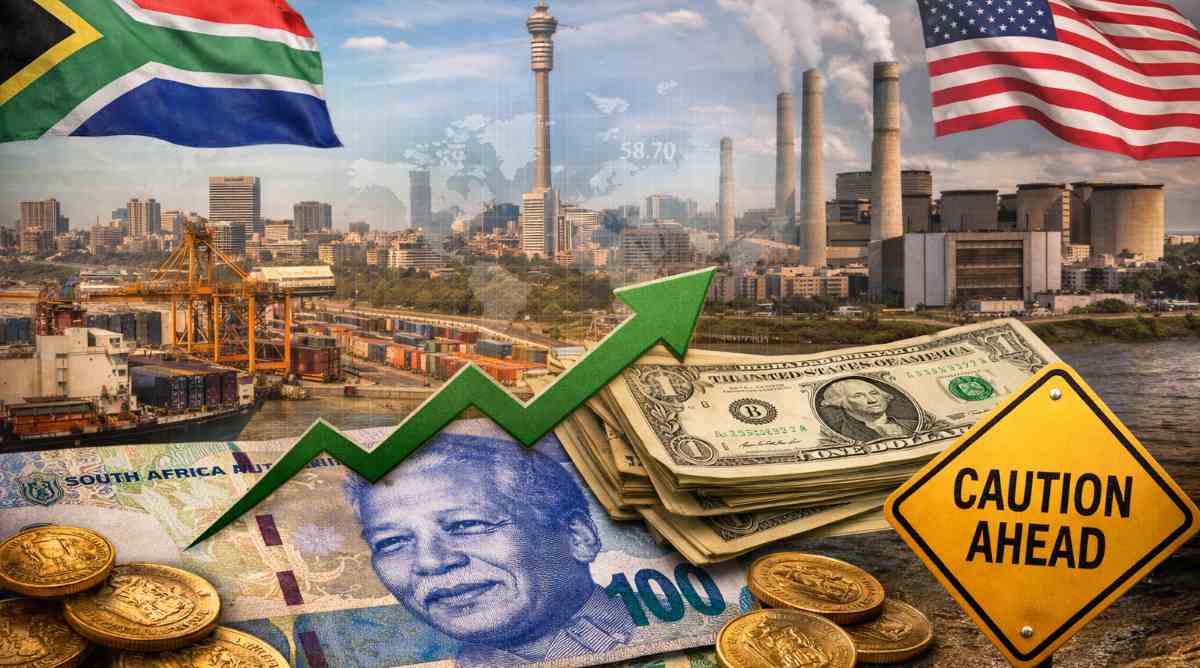
In recent months, the South African rand has delivered a performance that few would have confidently predicted at the start of the year. After prolonged periods of volatility and weakness, the currency has strengthened noticeably against major global currencies, particularly the US dollar.
As of today, the rand is trading at about R15.84–R16.10 to the US dollar, marking one of its strongest positions against the greenback since mid-2022.
This improvement builds on a broader trend: the rand gained over 10–13 % against the dollar in 2025, one of its best annual performances in more than a decade, driven by a combination of global and domestic factors that supported investor confidence.

In recent months, the South African rand has delivered a performance that few would have confidently predicted at the start of the year.
After prolonged periods of volatility and weakness, the currency has strengthened noticeably against major global currencies, particularly the US dollar.
As of today, the rand is trading at about R15.84 to the US dollar, marking one of its strongest positions against the greenback experienced over the past decade. This shift reflects a notable turnaround from the wider trading ranges seen over the past several years, when the currency frequently oscillated well above R18 against the dollar during heightened global uncertainty.
This improvement builds on a broader trend that unfolded through 2025, during which the rand gained more than 10 % against the dollar, making it one of the better-performing emerging market currencies.
The rand’s gain wasn’t isolated to the dollar — it also strengthened against the euro and the British pound over the same period.
For ordinary South Africans, this has translated into expectations of cheaper imports, potential fuel price relief, and renewed optimism that the country’s economic outlook may be improving — though analysts caution these perceptions may overstate the durability of the currency’s gains.
The Global Forces Behind the Rand’s Recent Strength
One of the primary drivers behind the rand’s recent performance lies outside South Africa’s borders. The US dollar — the world’s dominant reserve currency — has softened in global markets amid shifting expectations around Federal Reserve policy.
After an extended period of elevated interest rates, markets began pricing in a more dovish outlook, reducing demand for dollar-denominated assets. As a result, investors moved capital into emerging market assets that offered comparatively higher yields, including South African bonds.
This dynamic is known in financial markets as the “carry trade,” where investors borrow in low-yield currencies and invest in higher-yield ones. South Africa’s relatively high repo rate — which has remained firm compared with many advanced economies — made rand-linked assets attractive to yield-seeking capital.
This foreign investment in South African debt instruments helped shore up demand for the rand, contributing to its appreciation.
At the same time, broader risk sentiment in global markets improved. The rand is one of the most actively traded emerging market currencies, and market participants often use it as a proxy for emerging market risk. When global risk appetite increases, so too does demand for the rand. Conversely, in risk-off environments, the currency tends to weaken quickly.
Throughout the latter half of 2025 and into 2026, periods of reduced geopolitical tension and stabilising global growth data encouraged investors to return to risk-linked assets.
Commodity Prices and External Balances
South Africa’s role as a major commodity exporter has also played into the rand’s recent gains. The country is a leading producer of gold, platinum group metals (PGMs), coal, and iron ore — all of which have seen price resilience amidst global demand, particularly from Asia.
When commodity prices rise, South Africa benefits from increased export revenues, which in turn supports the current account and increases inflows of foreign currency. In the past year, gold and PGM prices showed notable strength, buoyed by safe-haven demand and industrial use, respectively. As export receipts rise, so too does the demand for rand, which exporters need to convert back to local currency when repatriating earnings.
It’s important to note, however, that while higher export prices boosted foreign exchange inflows, South Africa’s export sectors still grapple with logistical bottlenecks.
Ports and rail infrastructure under Transnet have faced ongoing challenges, from vessel delays at Durban to underinvestment in freight rail.
Despite these constraints, export volumes held up, underscoring the resilience of commodity-linked revenue even when infrastructure struggles persist.
Local Developments and Investor Confidence
Domestically, several factors helped improve investor sentiment. Reduced levels of load shedding contributed to a perception — both locally and internationally — that South Africa’s energy crisis might be stabilising. However, this could be a false sense of security especially when considering SA’s history on the subject. While load shedding has not disappeared, the frequency and severity of outages eased enough for markets to take notice.
Political developments also played a role. The formation of the Government of National Unity (GNU) appeared to temper some of the extreme political uncertainty that had weighed on markets in prior years. While the GNU hasn’t resolved South Africa’s deeper governance and corruption challenges, it has delivered a degree of political continuity that markets favour.
These combined developments — softer dollar, commodity price support, stabilising load shedding, and political continuity — helped underpin confidence in the rand among foreign investors and local market participants alike.
The Structural Reality Behind the Numbers
Despite these positive signals, economists caution that the rand’s strength may not reflect fundamental improvements in the South African economy. Nevertheless, the country continues to face persistent structural challenges:
- Low economic growth: GDP growth remains subdued, with expansions well below long-term averages.
- High unemployment: A jobless rate that consistently ranks among the highest globally dampens consumer demand and economic dynamism.
- Infrastructure bottlenecks: Logistics systems, including ports and rail, remain under strain and are plagued by mismanagement, constraining export potential.
- Municipal instability: Local governance hurdles continue to affect service delivery and investor confidence at sub-national levels. The continued audits from the Auditor General reveals a municipal sector nearing catastrophic failure on a national level due to mismanagement and corruption.
- Public debt pressures: South Africa’s debt-to-GDP ratio remains elevated, limiting fiscal space for investment and reform.
These structural issues have not gone away; they are simply less visible in currency movements when capital flows are influenced more by global sentiment than by domestic fundamentals.
Furthermore, credit rating agencies have taken note.
Despite the rand’s recent rally, South Africa remains in sub-investment (“junk”) credit status with major international agencies, which signals continued risk and limits the potential for a sustained inflow of long-term capital without reforms.
Is the Rand’s Strength Misleading?
This brings us to the critical distinction: A strong currency does not necessarily equate to a strong economy. In the case of the rand, much of the improvement stems from external capital flows and favourable global conditions, rather than broad-based domestic economic transformation.
For ordinary citizens, a stronger rand can create the illusion of progress.
Many expect immediate benefits such as lower fuel prices or cheaper imported goods. In practice, these benefits often arrive slowly, if at all, because pricing adjustments in markets lag behind currency movements. Likewise, businesses with local cost bases don’t automatically pass savings on to consumers.
Moreover, perceived strength can reduce the political and business urgency to pursue hard-edged reforms. If markets appear content with the status quo, the pressure to tackle deep-rooted challenges such as labour market rigidity, energy sector reform, and logistics modernisation diminishes.
What Could Reverse the Trend?
History suggests that the rand’s strength can be as temporary as it is dramatic. Periods of notable appreciation — such as those seen in 2010–2012 during the commodity boom, and again in 2017 on the back of political optimism — were followed by sharp reversals once global or domestic conditions shifted.
Therefore, several developments could similarly weaken the currency again:
- A resurgence of the US dollar due to renewed rate-hike expectations
- Falling commodity prices
- Deterioration in energy supply or load shedding
- Renewed political uncertainty
- Global risk-off episodes
In such scenarios, capital could exit emerging markets rapidly, leaving the rand vulnerable once more.
Furthermore, the rand’s recent performance is, without doubt, welcome news for many South Africans. It offers a measure of short-term relief in a challenging economic environment. But it is important to understand the difference between currency movements and economic fundamentals.
As it stands, the rand’s strength largely reflects favourable global winds and investor behaviour — not deep-seated structural transformation within the South African economy.
Whether this performance presages lasting improvement or simply a temporary reprieve is the critical question policymakers, investors, and citizens must now consider.
For now, the currency tells a story of opportunity, not yet transformation.
What are your thoughts on this? Let us know below.
Be sure to read, Australian gold exports to overtake LNG as second-largest national earner, if you missed it.
Why is the South African rand getting stronger?
The rand has strengthened due to a weaker US dollar, high local interest rates attracting foreign capital, and strong commodity prices.
Does a strong rand mean the economy is improving?
Not necessarily. Economists warn the strength reflects global factors rather than deep structural improvements.
What could cause the rand to weaken again?
US interest rate changes, falling commodity prices, political instability, or energy supply issues.


Reader discussion
Join the conversation