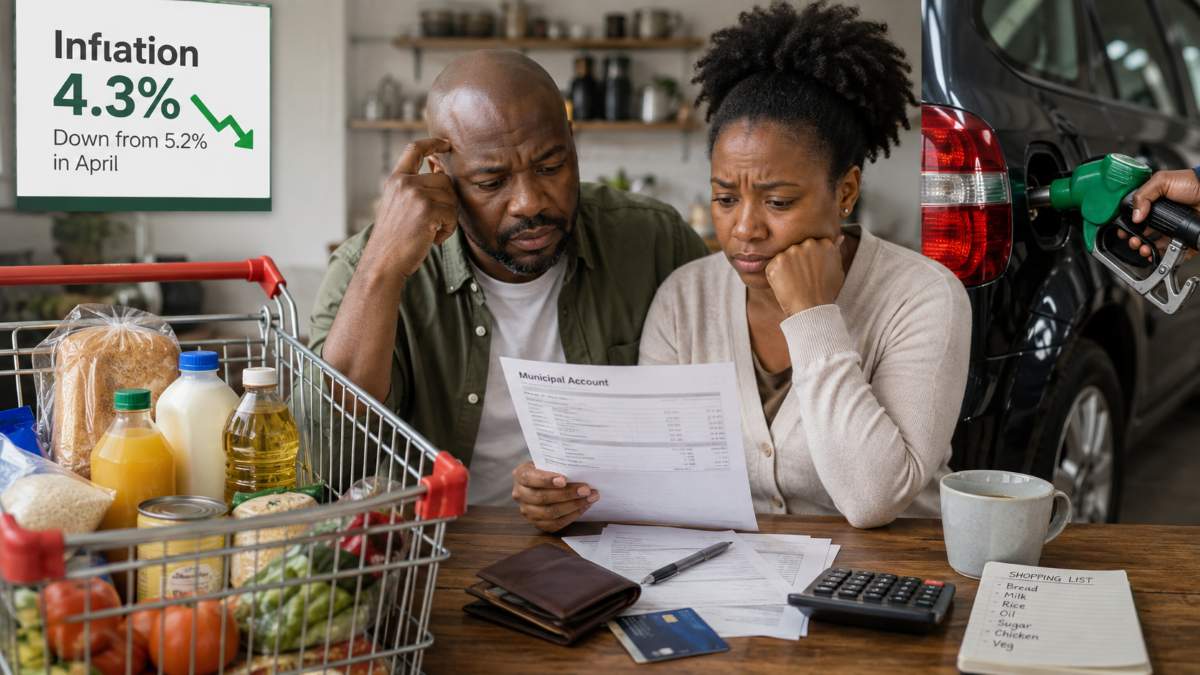
South Africa received some seemingly good economic news this week: consumer inflation fell to 4.3% in July 2026, down from 5% in June.
Unfortunately, your bank account may not have received the memo.
Electricity is more expensive. Water is more expensive. Petrol remains substantially more expensive than it was a year ago.
And depending on what lands in your grocery trolley every month, your own experience of rising prices may look very different from the national inflation figure.
So, if inflation has dropped to 4.3%, why doesn’t life suddenly feel cheaper?
The answer starts with an important distinction that often gets lost in the headline:
A lower inflation rate does not necessarily mean prices are falling. It means the overall rate at which prices are increasing has slowed.
According to Statistics South Africa’s latest Consumer Price Index (CPI) release, published on Wednesday, 19 August 2026, headline consumer inflation slowed from 5% in June to 4.3% in July.
Prices across the CPI increased by an average of 0.2% between June and July.
In other words, South Africans are not suddenly paying 4.3% less for everyday life.
Broadly speaking, the basket of goods and services measured by Stats SA costs more than it did a year ago — just at a slower annual rate than it did in June.
Think of it as taking your foot slightly off the accelerator rather than putting the car into reverse.
First, what exactly is this 4.3% measuring?
Stats SA does not arrive at inflation by watching the price of one loaf of bread, one tank of petrol or one municipal account.
South Africa’s current CPI basket contains 391 products and services. These represent a wide range of things households spend money on, from food and transport to housing, electricity, insurance and recreation.
Not every item counts equally.
Each product or category is given a weight based broadly on its relative share of South African household expenditure. Something on which households collectively spend a large amount therefore has a greater influence on headline inflation than something that represents a tiny portion of overall spending.
This immediately explains one of the biggest frustrations with inflation statistics:
Your household is not the CPI basket.
A pensioner who hardly drives, a family running two vehicles, a university student renting a room and a household with three school-going children all spend their money differently.
They can therefore experience rising living costs very differently even though they live in the same country under the same 4.3% headline inflation rate.
Groceries actually delivered some good news
One of the biggest reasons inflation slowed in July was food.
Annual inflation for food and non-alcoholic beverages dropped to just 0.9%, its lowest level in more than 16 years.
Some staple foods even became cheaper.
Between June and July, the average price of maize meal declined by 3.1%, macaroni by 0.7% and white bread by 0.6%.
There were also striking annual declines in some fresh beef products.
Compared with July 2025:
- Stewing beef was 7.9% cheaper
- Beef steak was 6.1% cheaper
- Beef mince was 5.8% cheaper
That is genuine price relief.
But before firing up the braai in celebration, the rest of the meat aisle tells a slightly different story.
Over the same 12 months:
- Corned meat increased 11.8%
- Meat patties increased 7.8%
- Russians increased 7.7%
- Sausages increased 6.2%
Fish products also recorded notable monthly increases, while inflation accelerated in several other food categories, including fruit and nuts, vegetables, oils and fats, dairy and eggs.
This is precisely why somebody can hear that “food inflation is only 0.9%” and still stare at a till slip wondering what on earth the statisticians are talking about.
It depends enormously on what you buy.
If the foods your household purchases most often happen to be among those rising faster than average, your grocery experience will not resemble the headline figure.
Then your municipal account arrives
This is where the picture becomes considerably less cheerful.
July is traditionally the month when municipalities implement their annual tariff increases, and Stats SA records those increases as part of CPI.
In 2026, average municipal tariff increases measured by Stats SA included:
- Electricity: 8.1%
- Water: 10.2%
- Sewerage: 7.8%
- Refuse removal: 4.7%
- Property assessment rates: 4.9%
There is some comparatively good news hidden there.
Electricity increased by 10.4% in 2025, meaning this year’s 8.1% increase was lower.
Water tariffs rose 12.1% last year compared with 10.2% this year, while refuse removal inflation also slowed.
But “increased by less than last year” and “became cheaper” are two very different sentences.
Water rising by 10.2% is still water rising by 10.2%.
And this provides another clue as to why one household’s experience may feel considerably worse than 4.3%.
A household spending a large part of its income on electricity, water, rates and other administered costs may feel those increases much more intensely than the headline inflation figure suggests.
Petrol came down — but zoom out before celebrating
Motorists received genuine relief during July.
Petrol prices fell 7.1% between June and July, while diesel dropped by 11.7%.
That monthly drop helped cool overall transport inflation significantly.
However, compare prices with a year earlier and things look rather different.
According to Stats SA:
Petrol remained 19.3% more expensive than in July 2025.
Diesel remained 28.8% more expensive.
So a motorist can quite correctly say fuel became cheaper in July while simultaneously complaining that fuel remains considerably more expensive than it was last year.
Both statements can be true.
For a South African who drives substantial distances every month, that annual increase can also carry more weight in their personal budget than it does in the national CPI calculation.
The person doing 300 kilometres a month and the sales representative doing 3,000 kilometres are not experiencing the same fuel-price reality.
So is 4.3% actually good news?
Yes.
Slower inflation is generally preferable to rapidly accelerating inflation because it means the overall pace of price increases is easing.
July’s figure is especially noteworthy because headline inflation had risen for four consecutive months before finally cooling.
Food inflation slowing to its lowest level since 2010 is also meaningful. Lower fuel prices during July provided genuine relief, while this year’s electricity and water tariff increases were at least smaller than those implemented in 2025.
But none of that means the cost-of-living pressure accumulated over previous months and years simply disappears.
This is the part worth remembering whenever someone says inflation has “come down”.
Imagine something cost R100.
It rises by 10%, taking the price to R110.
The following year, inflation on that item slows to 4%.
The price does not return to R104.
It rises another 4% from R110, taking it to R114.40.
The inflation rate came down dramatically.
The price still went up.
That simple distinction explains a great deal about why official inflation figures and everyday experience can sometimes appear to tell different stories.
Your personal inflation rate matters too
There is no single South African household.
And Stats SA does not claim there is.
The CPI is a national statistical measure built from weighted household expenditure patterns. Stats SA also produces indices for different geographical and income groups precisely because spending patterns and inflation experiences differ.
Your own effective cost-of-living increase depends on what consumes your money.
If a large portion goes towards products whose prices are rising faster than 4.3%, your household can feel squeezed even while national inflation falls.
If you spend heavily on products whose prices are falling or barely increasing, the opposite can happen.
That does not make the national CPI wrong.
It simply means 4.3% describes South Africa’s weighted inflation basket — not your individual bank statement.
And that is probably the most useful way to read this week’s inflation news.
South Africa’s inflation rate has fallen.
Some important price pressures are easing.
Some products really have become cheaper.
But electricity, water, fuel and several everyday food products show why many households may not yet feel as though life has suddenly become affordable.
The statisticians and your wallet are not necessarily disagreeing.
They may simply be measuring two different things.
Be sure to read: Why The Marketing Degree is Outdated in Today’s Fast-Evolving Industry


Reader discussion
Join the conversation