
The Newcastle, KwaZulu-Natal landfill crisis has become a symbol of municipal decay in KwaZulu-Natal. In the shadow of smouldering waste piles and acrid fumes, residents have endured years of neglect that turned the town’s main dump into a ticking environmental bomb.
What began as a slow-burning capacity problem erupted into a month-long inferno this September — shutting down roads, forcing helicopter interventions, and leaving thousands gasping for clean air. Now, following a scathing oversight visit by the KwaZulu-Natal Legislature, the municipality faces mounting pressure to deliver on long-promised reforms or risk an ecological disaster that could engulf the community once more.
A landfill long past its lifespan
Newcastle’s primary landfill has been operating for nearly 55 years, far beyond its design capacity. The issue was flagged repeatedly, yet for more than a decade officials downplayed the risks.
During the May 2025 Integrated Development Plan (IDP) roadshows, residents directly confronted municipal leaders over uncollected refuse, overflowing bins, and clear non-compliance with national standards. Councillor Bertie Meiring acknowledged the gravity and declared a new site was critical, with the current landfill having exceeded its lifespan by roughly a decade. Prolonging its use would impose an unsustainable financial burden on the already cash-strapped municipality. — Newcastillian News, May 2025
A potential replacement site within Utrecht’s (now eMadlangeni) borders was identified in 2024, advancing to the Environmental Impact Assessment (EIA) phase with eight specialist studies completed. Officials hoped for a decision by late 2025 or early 2026. Yet for residents breathing the fallout, patience has worn thin.
From overload to inferno
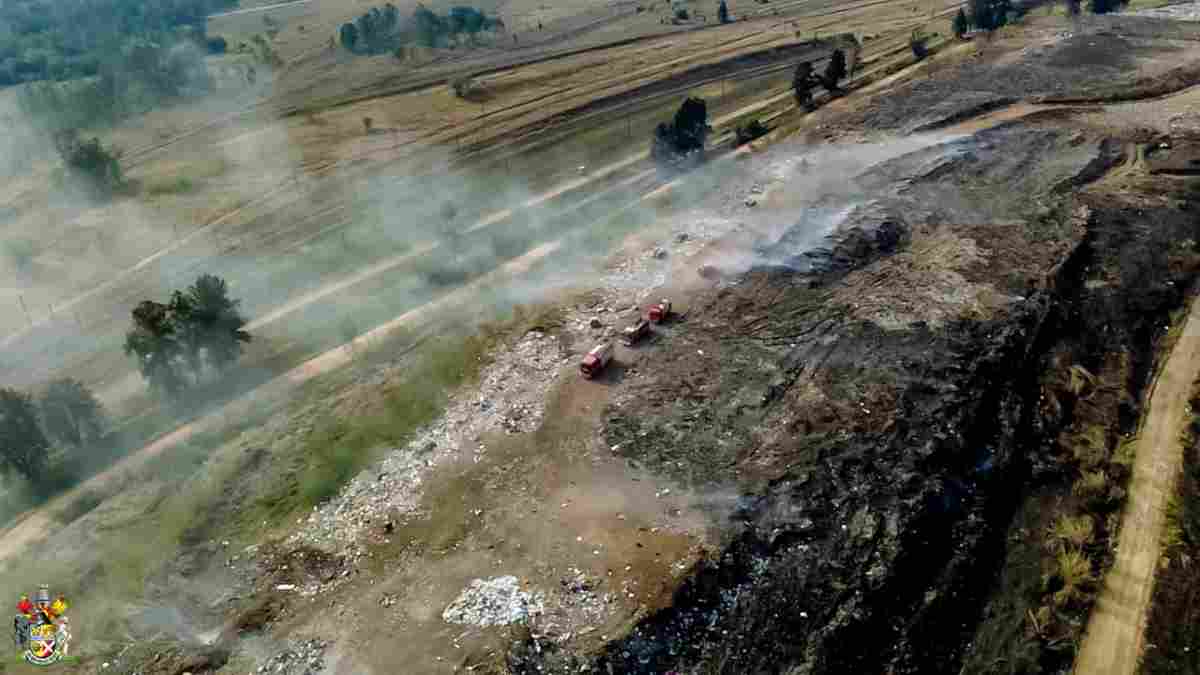
The situation reached breaking point on 4 September 2025, when a fire ignited deep within the refuse mass. Uncovered waste, high winds and methane buildup turned the site into a furnace. Local firefighters fought for days, but the flames reignited across internal access roads, blanketing large parts of Newcastle in toxic smoke.
By 16 September, visibility dropped so severely that authorities closed the N11–P483 intersection; a second closure followed days later. On 20 September, exhausted ground crews were joined by a Working on Fire helicopter from Melmoth, which scooped water from Amcor Dam to suppress the flames from above.
Despite these measures, the fire raged for nearly a month. It mirrored a similar August 2023 blaze, exposing a pattern of preventable failures.

Health and air-quality failures
As the inferno spread, the KwaZulu-Natal air-quality monitoring network lay in collapse. None of the province’s six stations — including Newcastle’s — were operational due to suspended maintenance budgets.
The Department of Economic Development, Tourism and Environmental Affairs (EDTEA) had not conducted any recent human-health risk assessments, leaving families exposed to unknown levels of airborne toxins. Residents reported headaches, nausea and eye irritation, while schools and businesses battled the stench.
Oversight exposes deep decay
The crisis prompted a high-level legislative oversight visit by the KZN Legislature’s Conservation Portfolio Committee on 1 October 2025. Led by member Hannah Winkler, the committee found conditions far worse than expected.
Inspectors discovered gaping holes in the perimeter fencing, open leachate pools contaminating soil and groundwater, and large swaths of smouldering, uncovered waste emitting chemical odours. Daily cover protocols — legally required to prevent fires — had not been applied since mid-2024.
The site’s compliance rating had dropped to 22% in 2024 from 30% the previous year — one of the lowest in KwaZulu-Natal, where only two of ten audited sites met minimum legal standards.
Compounding the problem was a collapsed operational fleet. The municipality owned four steel-wheel compactors but only two were functional; the rest had been out of service for nearly five years. To keep operations going, the city relied on leased excavators and bulldozers — a costly and inefficient stopgap.
A budget that buries the problem
According to municipal figures, the waste-management budget sits at roughly R123 million. More than R55 million goes to salaries, while just R180 000 is allocated to daily operations — a staggering imbalance given monthly billing revenues of around R11.3 million.
Directives and deadlines
The legislative committee issued immediate directives, including:
- Covering all hot spots to suppress residual fires.
- Accelerating recycling and source-separation programmes to reduce landfill volumes.
- Submitting quarterly compliance reports to the KZN Legislature.
- Urgent investment in firefighting equipment, machinery, and leachate control systems.
Municipal officials confirmed “some progress” since the visit but conceded that key gaps remain. Short-term waste diversion could extend the current site’s lifespan by up to three years — but only if funding, equipment and proper oversight are secured quickly.
The road ahead
With the EIA for the eMadlangeni replacement site expected to conclude by December, Newcastle’s window to act is closing. The community remains scarred by the thick smoke and lingering odours of the September fire, while environmental groups continue to press for accountability.
The inferno may be out, but the embers of responsibility still glow. Whether the municipality turns them into reform — or allows them to reignite — will determine Newcastle’s environmental future.
Reader discussion
Join the conversation