
A viral claim suggests that dandelion root extract kills 95% of leukaemia cells, based on research allegedly conducted in Canada. While this idea has sparked hope and widespread social media attention, it’s essential to examine what the science truly says. In short, while dandelion root extract leukaemia studies do exist, they are lab-based and not clinically proven in humans.
What Sparked the Dandelion Root Extract Leukaemia Claim?
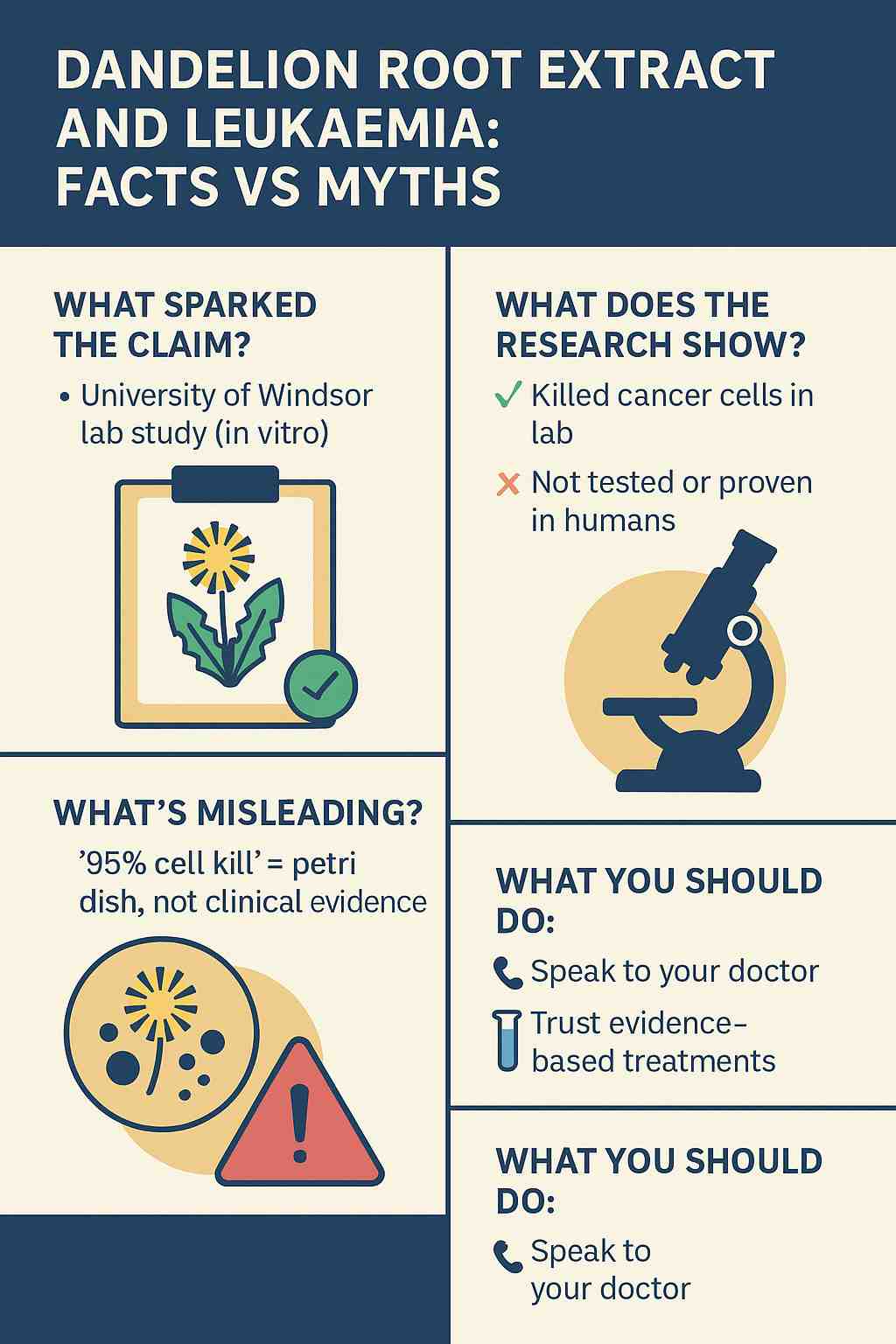
The origins of this widely shared claim trace back to in vitro studies at the University of Windsor in Canada, where researchers explored how dandelion root extract affects cancer cells. Early findings suggested the extract could trigger apoptosis (programmed cell death) in certain cancer types, including leukaemia, pancreatic, and colon cancer cells.
However, these results were limited to petri dish experiments and do not translate into an effective treatment for real-world patients.
No Human Trials Prove Dandelion Root Extract Cures Leukaemia
Despite online posts suggesting otherwise, no clinical trial has proven that dandelion root extract cures leukaemia in humans. A small-scale Phase I clinical trial was approved in Canada in 2015 to test its safety, but it never reached completion due to recruitment and funding challenges. As of 2025, no peer-reviewed clinical datasupports the use of this extract as a medical treatment for cancer.
This highlights a key issue with how dandelion root extract leukaemia claims are often exaggerated — turning preliminary lab results into misleading medical promises.
What Lab Research on Dandelion Root Really Shows
- Dandelion root extract has shown cancer cell-killing effects in laboratory studies involving leukaemia and other cancers.
- These tests were conducted outside the human body, meaning they lack the complexity of how real patients respond to treatment.
- The extract appears to induce cell death through various mechanisms, but this is far from a verified treatment pathway.
Even in promising lab results, substances that kill cancer cells in vitro often fail to work safely or effectively in human trials.
Why the Dandelion Root Extract Leukaemia Narrative Is Misleading
The claim that dandelion root extract cures leukaemia is misleading for several reasons:
- ✅ The 95% cancer cell death rate was observed in a petri dish, not in human patients.
- ✅ No regulatory agency, including Health Canada or the FDA, has approved dandelion root as a cancer treatment.
- ✅ Anecdotal reports — including cases where patients drank dandelion tea — are not scientific evidence.
Promoting such claims may cause desperate patients to abandon medically proven treatments, which can lead to dangerous outcomes.
Should You Take Dandelion Root for Leukaemia?
While dandelion root is used in herbal medicine for liver support and digestion, its role in cancer therapy remains unproven. It is generally safe in small doses, but it is not recommended as a treatment for leukaemia or any cancer.
Patients interested in complementary therapies should speak to their oncologist first. Some herbal products can interfere with chemotherapy or reduce its effectiveness.
Long Story Short: Dandelion Root Extract Leukaemia Claims Lack Clinical Proof
Although early laboratory research into dandelion root extract leukaemia effects has sparked widespread curiosity, it remains just that—preliminary research. To date, no clinical trials in humans have confirmed the extract to be safe, effective, or reliable as a cancer treatment. Claims that it “kills 95% of cancer cells” are based entirely on in vitro studies, which involve isolated cancer cells in a petri dish—not within the complexity of the human body.
There is a vast gap between a lab result and a medical breakthrough, and this gap is often ignored by those pushing unverified health claims.
It’s critical for the public to understand that even natural compounds with promising lab outcomes rarely translate into actual treatments. Many substances can destroy cancer cells in a controlled lab setting, but that does not mean they’re safe or effective when introduced to the human system. Without large-scale, peer-reviewed clinical evidence, these claims remain scientifically unsupported and medically irresponsible.
As always, cancer treatment decisions must be guided by evidence-based medicine—not anecdotal claims, viral social media posts, or opportunistic influencers chasing engagement. While hope plays a valuable role in any health journey, it must be rooted in scientific integrity and trusted medical guidance, not in pseudoscience, hype, or another shameless individual looking for clicks at the expense of vulnerable patients and their families.
Do not take medical advice from social media platforms! That is like asking a 4 year old to operate on you, thinking it is a good idea and later, filled with regret, you wonder why you did not follow the tried and tested avenues.
Frequently Asked Questions About Dandelion Root Extract and Leukaemia:
Does dandelion root extract really kill leukaemia cells?
Some lab studies (in vitro) have shown that dandelion root extract can trigger the death of leukaemia and other cancer cells in petri dishes. However, this has not been tested or confirmed in human clinical trials, so it cannot be considered a proven treatment for leukaemia.
Is dandelion root extract a cure for leukaemia?
No. Despite claims circulating online, dandelion root extract is not a cure for leukaemia. While early-stage lab research has sparked interest, there is no clinical evidence that it is effective or safe for treating cancer in people.
What does research say about dandelion root extract leukaemia treatment?
Current research into dandelion root extract leukaemia treatment is limited to preclinical lab studies. These studies show potential in a laboratory setting but lack the clinical trials necessary to confirm any real-world medical application or benefit.
Can I take dandelion root extract alongside cancer treatment?
Always consult your oncologist or medical professional before using any herbal supplement, including dandelion root extract. Some supplements may interact with chemotherapy or other treatments, and relying on unproven remedies can be dangerous.
Be sure to read, Credit Scores That Work: How to Improve and Save Money, if you missed it.


Reader discussion
Join the conversation