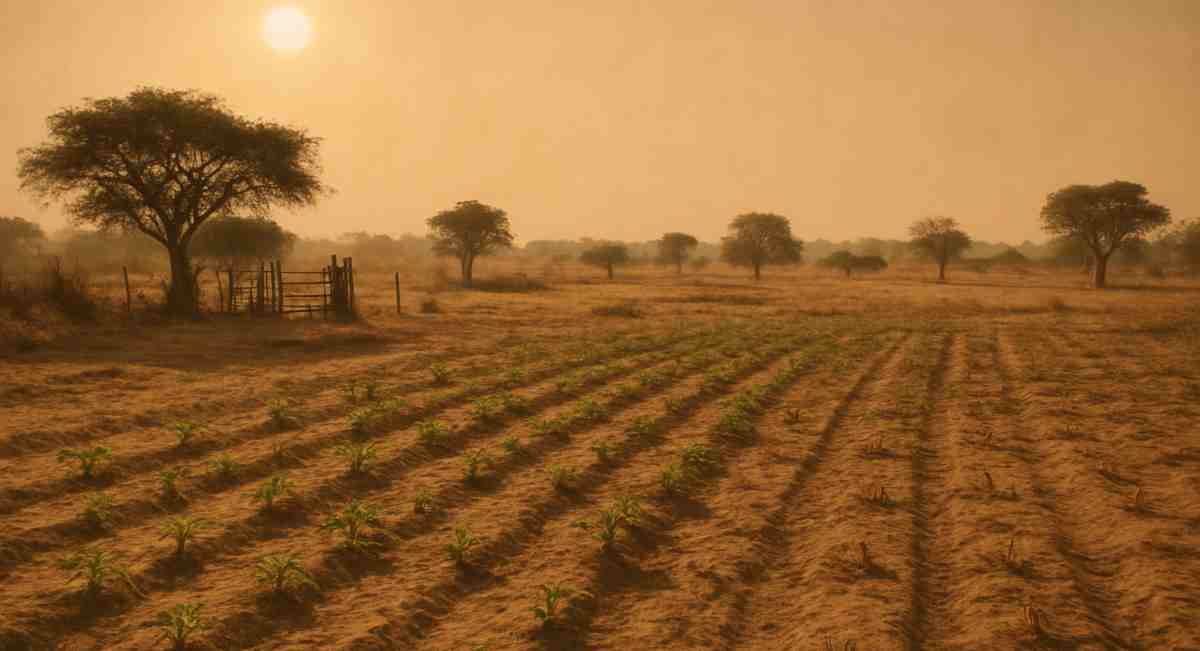
President Cyril Ramaphosa has drawn attention after praising Zimbabwe’s agricultural sector during the 130th Zimbabwe Agricultural Show in Harare on 29 August 2025. His remarks lauded Zimbabwe’s focus on irrigation, mechanisation, and resilience-building programmes, suggesting that South Africa could learn from its northern neighbour.
But for many South Africans, Ramaphosa’s comments stir uncomfortable, disturbing memories.
Zimbabwe’s agricultural system is infamous for its violent land seizures in the 2000s, when the government under Robert Mugabe sanctioned the forced removal of white commercial farmers, often through the use of the army and political militias.
The Context of Zimbabwe’s Land Reform
What Ramaphosa framed as a “shining example” stems from one of the most controversial land reforms in modern African history. In the early 2000s, Zimbabwe launched its fast-track land reform programme, violently seizing thousands of commercial farms. Farmers were beaten, dispossessed, or killed, and much of the land was redistributed to politically connected elites rather than to ordinary smallholders.
The result was catastrophic: Zimbabwe’s economy collapsed, hyperinflation spiralled, and a country once known as the “breadbasket of Africa” fell into food insecurity, forcing millions to flee.
What Ramaphosa Praised
At the Agricultural Show, Ramaphosa singled out initiatives such as:
- The Pfumvudza/Intwasa Programme – promoting conservation agriculture for small-scale farmers.
- The Presidential Goat Scheme and Borehole Drilling Projects – aimed at boosting livestock farming and irrigation.
- Mechanisation and Input Support – efforts to modernise farming and stabilise production.
These schemes, while showing recent signs of improved yields, cannot be separated from the violent dispossession and economic decline that made them necessary in the first place.
South African Implications
Ramaphosa’s remarks may reflect political positioning at home, where land reform remains a pressing but divisive issue. By highlighting Zimbabwe’s agricultural recovery, he could be signalling to factions within the ANC that redistribution—even if controversial—can eventually lead to stabilisation.
Yet critics argue that praising Zimbabwe without acknowledging the human and economic cost risks whitewashing history and sending mixed messages to South Africans and the world. Land reform can be just, but Zimbabwe’s path shows how easily it can also become destructive.
A Fragile “Success Story”
While Zimbabwe’s smallholder farmers have benefited modestly from input schemes, the broader picture is far less triumphant. The country still imports staples, inequality remains entrenched, and the agricultural system operates under heavy state intervention.
For many observers, Zimbabwe’s agricultural recovery should be viewed not as a model, but as a warning: policies rooted in dispossession and political favouritism may bring temporary gains but leave lasting scars.
What are your thoughts on this? Let us know below.
Be sure to read, Global Perceptions of South Africa in 2025: Governance, Economy, and Image, if you missed it.
Reader discussion
Join the conversation