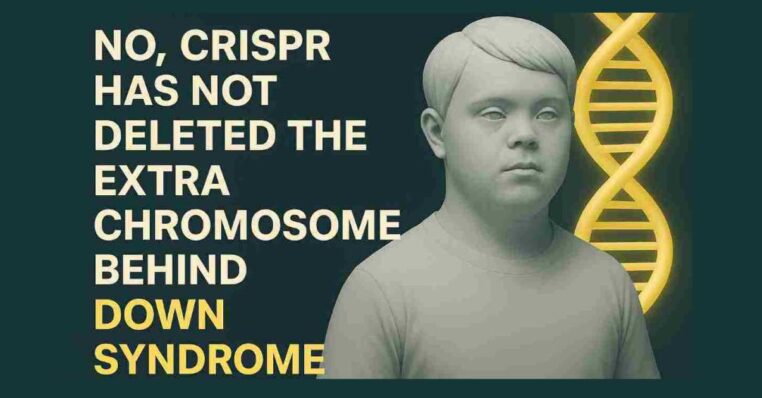
A viral image claiming that scientists have used CRISPR to delete the extra chromosome behind Down syndrome is currently flooding social media platforms. However, this CRISPR Down Syndrome breakthrough hoax is just that — a hoax. Despite its viral popularity, there is no scientific evidence backing the claim, and it dangerously distorts public understanding of both Down syndrome and gene-editing technologies.
What Is Down Syndrome?
Down syndrome, medically referred to as Trisomy 21, occurs when an individual has a third copy of chromosome 21. This additional genetic material affects development and causes a range of physical and cognitive characteristics. While medical support and therapies have improved the lives of those with Down syndrome, no cure exists.
The CRISPR Down Syndrome Breakthrough Hoax
The viral post, which appears without any credible sources, claims Japanese scientists have deleted the extra chromosome using CRISPR technology. However, no peer-reviewed study, research institution, or geneticist has confirmed or even suggested that such a feat has been achieved in humans.

The CRISPR Down Syndrome breakthrough hoax misleads readers by implying that complete chromosome deletion is not only possible, but already accomplished — which is scientifically inaccurate.
What Science Actually Says
CRISPR is a revolutionary gene-editing tool that allows scientists to cut and alter specific sections of DNA. While it has shown promising results in correcting single-gene disorders, the idea of removing an entire extra chromosome is far more complex.
In a 2013 study at the University of Massachusetts Medical School, Dr Jeanne Lawrence and her team managed to silence the extra chromosome 21 in stem cells by inserting a gene called XIST. This experiment was performed in a lab setting, not in living humans, and involved switching the chromosome off — not deleting it.
You can view that study here: https://www.nature.com/articles/nature12564
Why the Hoax Spread So Fast
The CRISPR Down Syndrome breakthrough hoax is successful because it taps into several emotional and social triggers:
- Hope for families dealing with genetic conditions
- Fascination with advanced technologies like CRISPR
- Viral visuals that appear scientific, even when they’re not
- Lack of source-checking by users who share without verifying
What Makes the CRISPR Down Syndrome Breakthrough Hoax So Harmful?
False claims like these don’t just misinform — they can emotionally manipulate families, derail honest conversations about disability, and divert attention from the real scientific work being done to improve lives.
Even worse, misinformation weakens public trust in legitimate medical advances, making people more susceptible to further scams, pseudoscience, and unproven treatments.
The Real Outlook for CRISPR and Down Syndrome
CRISPR might one day support therapies that help individuals with Down syndrome live longer, healthier lives. But the science is not yet capable of removing or correcting an entire chromosome in humans. To claim otherwise is misleading — and potentially harmful.
Titus News Remains Committed to Accuracy
As a credible news platform, Titus News will continue to counter scientific misinformation with evidence-based reporting. The internet is full of eye-catching claims, but we’re here to make sure the facts don’t get lost in the noise. Therefore, it is vital that readers question posts like the CRISPR Down Syndrome breakthrough hoax before sharing them.
Be sure to read the following: The Future of Radiography: Why AI Won’t Replace Radiographers Anytime Soon
Has CRISPR been used to cure Down syndrome?
No. Despite viral claims, there is no scientific evidence that CRISPR has been used to cure or delete the extra chromosome behind Down syndrome in humans. Some lab-based experiments have shown potential in silencing the extra chromosome in cells, but these have not moved beyond Petri dishes and are not applicable to living individuals.
Is the CRISPR Down Syndrome breakthrough hoax true?
No, the post is misleading. It falsely claims that Japanese scientists have deleted chromosome 21 in humans using CRISPR. There is no peer-reviewed evidence or public documentation to support this. It’s a misinterpretation of earlier lab studies
What did scientists actually achieve with CRISPR and Down syndrome?
In 2013, researchers at UMass Medical School used a gene called XIST to silence the extra chromosome 21 in lab-grown stem cells. This was a controlled lab experiment and not a clinical breakthrough. No deletion occurred, and it has not been tested in human subjects.
Can CRISPR cure genetic conditions in the future?
CRISPR holds great potential for treating some genetic conditions, especially those caused by single-gene mutations. However, editing entire chromosomes — such as in Down syndrome — is far more complex and not currently achievable in clinical settings.


Reader discussion
Join the conversation