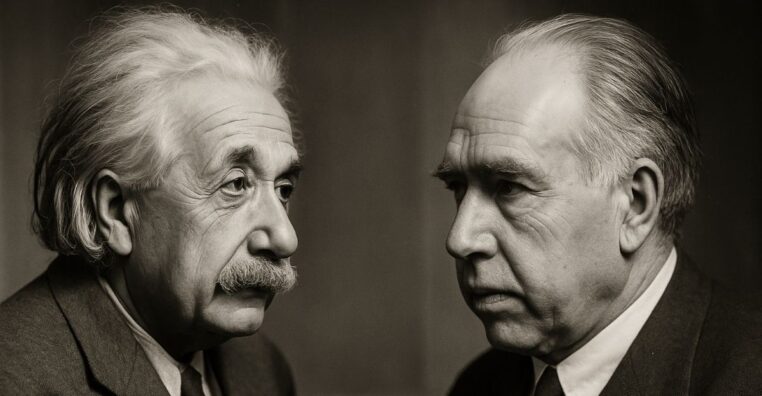
A new version of the MIT double slit experiment has delivered a major breakthrough in quantum physics. This latest experiment proves that Niels Bohr’s view of quantum mechanics was correct and that Albert Einstein’s theory of a fixed reality was wrong.
The MIT team used single photons and ultracold atoms to recreate a pure double slit setup. They arranged over 10 000 rubidium atoms in a crystal pattern just above absolute zero. These atoms acted as the slits. The team then fired one photon at a time through them.
What exactly happened with the MIT Double Slit Experiment?
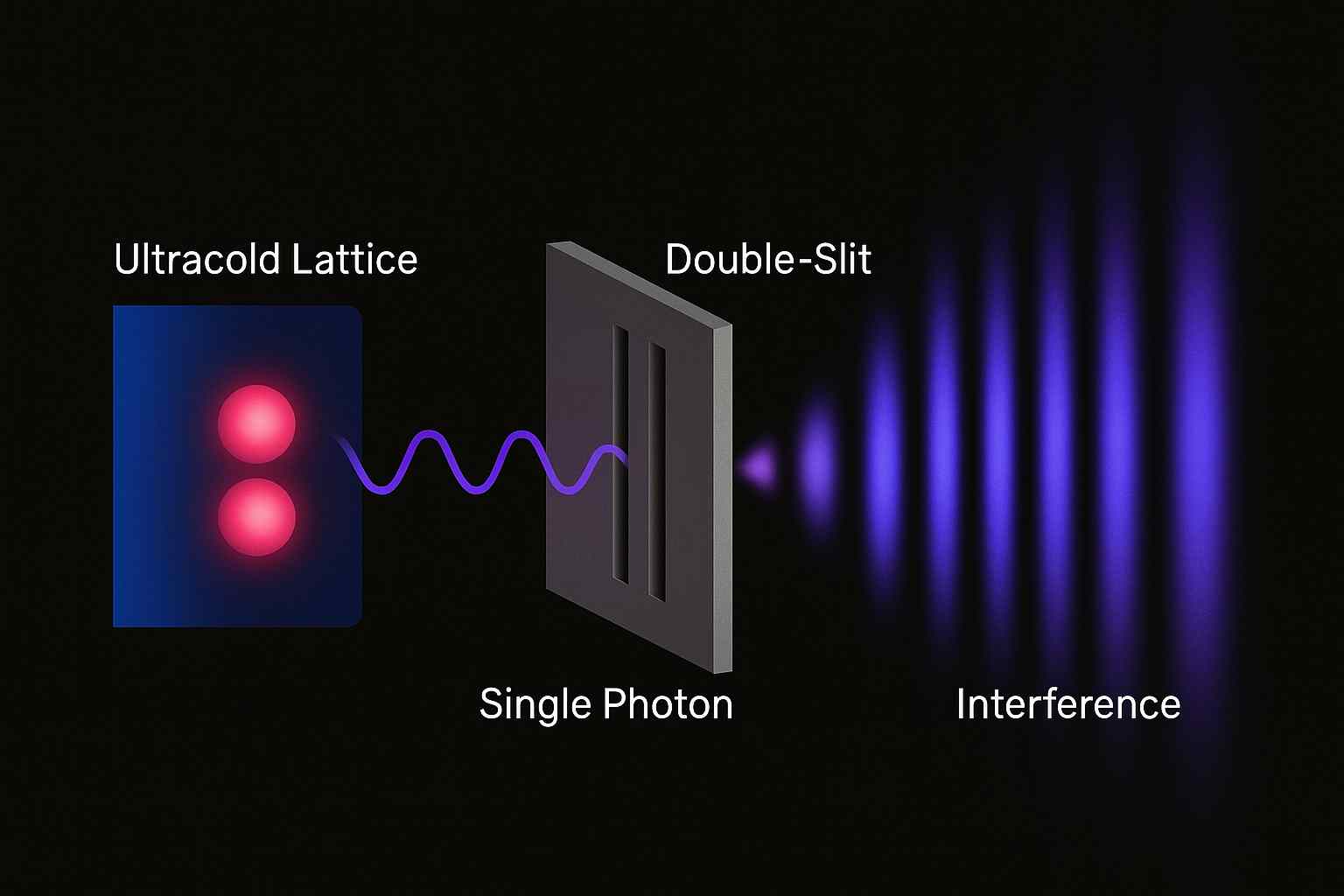
By adjusting how tightly the atoms were held in place the scientists could control how much information was available about the photon’s path. When they could tell which slit the photon used the interference pattern disappeared. When the path was unclear the interference pattern returned. This proves that photons cannot show wave and particle behaviour at the same time.
This direct trade off is exactly what Niels Bohr predicted. He said a quantum object can act like a wave or a particle but never both at once. The MIT double slit experiment confirms this theory and shows that observation shapes reality.
Einstein once suggested a person could observe both behaviours by measuring the recoil of the slit device. But this experiment proves that even the tiniest measurement disturbs the system.
Therefore, there is no way to know both the path and see the wave pattern at the same time.
According to the MIT research team the result is clear. The photon becomes entangled with the atom and the quantum system reacts. This is not caused by any physical device but by the laws of quantum mechanics themselves.
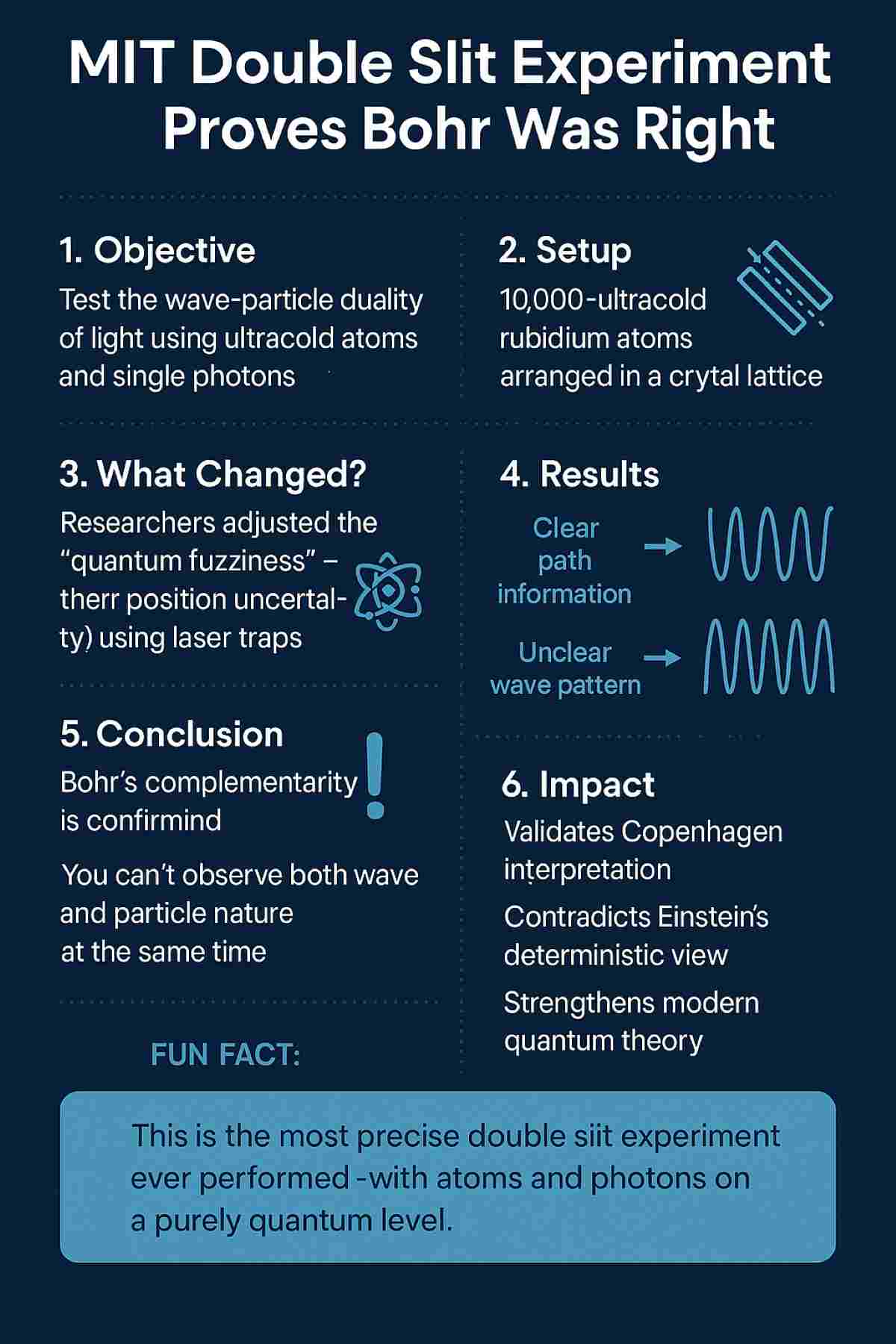
The results confirm the Copenhagen interpretation. This means particles like photons only take on fixed properties when they are observed. Before that they exist in a range of possible states.
Impact of the MIT Double Slit Experiment
The MIT double slit experiment was published in the journal Physical Review Letters. It is the cleanest and most accurate version of the experiment ever done. This changes how we understand reality and strengthens quantum theory. Bohr wins the argument once again. Einstein’s idea of a deterministic universe has taken another major hit.
Here Are Some FAQs: MIT Double Slit Experiment
What is the MIT double slit experiment?
It is a quantum physics experiment where MIT scientists used ultracold atoms and single photons to test how particles behave as waves or particles depending on how they are measured.
Why is this experiment important?
It gives the cleanest confirmation yet of Bohr’s quantum theory, showing that the way a particle behaves depends on how we observe it.
What did Einstein believe?
Einstein thought reality is fixed and measurable and that particles have properties even when we are not looking. He believed both wave and particle behaviour could be seen at the same time.
What did Bohr believe?
Bohr argued that you can only measure either the wave or particle behaviour but never both at once. This is called the complementarity principle.
What did MIT prove?
MIT proved that Bohr was right. Their experiment showed that when you try to see which slit a photon goes through, the wave pattern disappears — proving you cannot have both at once.
What is the Copenhagen interpretation?
It is a view of quantum mechanics stating that particles exist in multiple states until measured. Observation determines the outcome.
Where was this research published?
It was published in Physical Review Letters in July 2025.
Be sure to read, The Future of Radiography: Why AI Won’t Replace Radiographers Anytime Soon, if you missed it.

Reader discussion
Join the conversation