October 8, 2025 – International Desk
Thousands of Christians killed in escalating violence across Nigeria have drawn international alarm as targeted attacks continue to devastate faith communities in the country’s northern and Middle Belt regions. Human rights groups report that more than 52,000 Christians have been killed since 2009, with over 7,000 deaths recorded in 2025 alone — an average of nearly 30 fatalities per day.
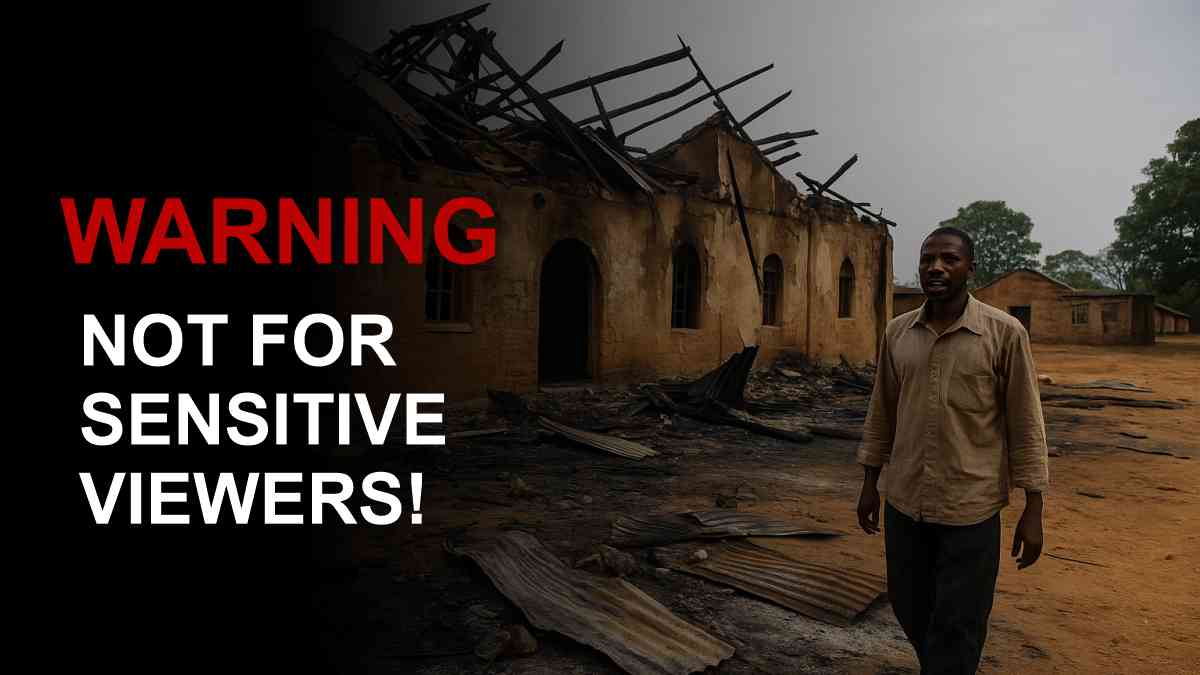
According to investigations by Open Doors International, Genocide Watch, and the U.S. Commission on International Religious Freedom (USCIRF), the Christian killings are predominantly carried out by Islamist militants, including Boko Haram and Fulani extremists, who raid villages, torch churches, and abduct or murder civilians. The violence has left millions displaced and thousands of churches and schools destroyed.
In one of this year’s worst incidents, militants attacked Yelwata in Benue State in July, killing at least 160 people, mostly Christians, and displacing thousands.
Just weeks later, on 24 September, Father Mathew Eya, a Catholic priest, was murdered in another assault targeting the clergy. Since 2009, over 18,000 churches and 2,000 Christian schools have been destroyed across Nigeria.
While many observers cite religious persecution, the Nigerian government attributes much of the bloodshed to ethnic and territorial conflicts between herders and farmers. The Christian Association of Nigeria (CAN) has rejected claims of a “Christian genocide,” stating that insecurity affects citizens of all faiths. However, rights groups warn that the pattern of attacks and their scale point to systematic religious targeting.
U.S. legislative pressure grows over thousands of Christians killed
The United States has taken the most assertive diplomatic stance on the issue. On 11 September 2025, Senator Ted Cruz (R-Texas) introduced the Nigeria Religious Freedom Accountability Act, proposing sanctions against Nigerian officials accused of complicity or negligence in protecting minority faith groups. Cruz cited over 50,000 Christian deaths since 2009, describing the crisis as “one of the world’s gravest human rights failures.”
On 7 October, Congressman Riley Moore (R–West Virginia) urged Secretary of State, Marco Rubio to reclassify Nigeria as a “Country of Particular Concern” under the International Religious Freedom Act, referencing the 7,000 Christian deaths in 2025 alone.
A July USCIRF report documented continued blasphemy prosecutions and failures to address non-state violence, calling for stronger international oversight.
Nigeria’s response has been defiant. Foreign Minister Yusuf Tuggar dismissed Cruz’s claims as “misinformation,” while the Nigerian Senate accused Washington of distorting the situation for political gain. Despite the exchange, the U.S. has yet to impose new sanctions as of early October.
South Africa’s silence amid thousands of Christians killed
South Africa, one of Nigeria’s closest regional partners, has strangely remained largely silent on the 2025 escalation. Neither President Cyril Ramaphosa nor Foreign Minister Ronald Lamola has issued formal statements. However, Open Doors South Africa reported in June that more than 200 Christians were killed and thousands displaced in Benue State, blaming the violence on Islamist herders. The South African Friends of Israel also raised alarm in September, criticising what it called a “concerning silence” from African leaders.
Analysts suggest that Pretoria’s reluctance reflects diplomatic caution within BRICS and the African Union, as South Africa seeks to maintain its relationship with Abuja while grappling with domestic issues such as farm violence, politically motivated racial tensions, corruption and economic pressure.
Global NGO efforts fill the vacuum
In the absence of coordinated state action, non-governmental organisations have taken the lead. Genocide Watch, in a 17 July 2025 report, warned of “deliberate targeting” of Christian populations in Nigeria’s Middle Belt, while Voice of the Martyrs Canada and International Christian Concern reported 7,000 Christian deaths between January and August 2025.
A Newsweek investigation on 5 October described the crisis as a “silent genocide,” estimating 125,000 Christian deaths since 2009. Al Jazeera, however, presented a counterview on 2 October, arguing that the violence cannot be reduced solely to religion, citing herder-farmer disputes and regional insecurity as overlapping causes.
Faith-based organisations such as the Catholic Register (Canada) have urged global prayer campaigns, while the Religious Freedom Institute has called for stronger U.S. and UN engagement. Despite these appeals, neither the United Nations nor the African Union has launched a formal intervention.
A crisis that transcends religion
Experts caution that Nigeria’s violence, while undeniably affecting Christians disproportionately, also reflects deeper issues of poverty, weak governance, and climate-driven migration. Expanding desertification in the north has forced herders southward into farming regions, fuelling decades of conflict over land and resources.
Furthermore, the Nigerian government insists its military campaigns have neutralised “thousands of insurgents,” yet communities on the ground continue to report mass displacement, impunity, and inadequate protection.
Human rights advocates warn that without sustained international involvement, the humanitarian toll will keep rising. The U.S. Commission on International Religious Freedom, Intersociety, and Open Doors have all called for coordinated sanctions, accountability measures, and increased humanitarian aid.
For the millions of displaced Nigerians — most of them Christian farmers — awareness alone is no longer enough. What remains absent, critics say, is political will to end a war that has turned faith into a fault line in Africa’s largest democracy.
What are your thoughts on this? Let us know below.
Be sure to read, Shared parental leave in South Africa: victory for fathers, challenge for UIF, if you missed it.